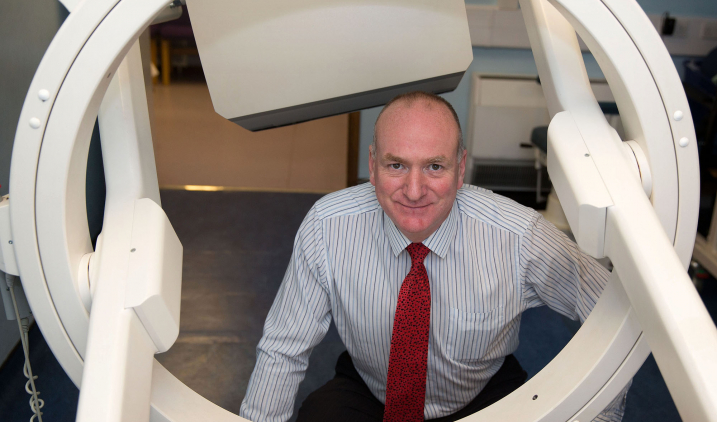
Clinical measurement is the development, use, on-going support, and maintenance of technology for diagnosing, aiding or treating patients.
In clinical measurement you’ll use your knowledge of materials and manufacturing to design, build and maintain a range of equipment.
"I enjoyed my degree but I was initially unsure how I wanted to apply it to a career. I wanted to do something where I could use my skills to help others." Darren Hart, a clinical scientist in physiological measurement
As a clinical or bio-engineer, you’ll design equipment for monitoring, diagnosing, treating and rehabilitating patients or work in research. You might design laser equipment or electronic aids for patients with disabilities and investigate the mechanics of the human body.
You’ll use physical sciences and your knowledge of materials and manufacturing to make significant contributions to the diagnosis and the treatment of disease, and to the rehabilitation of patients with disabilities.
You could be:
designing and developing instruments for patient monitoring, diagnosis, treatment or research
responsible for quality assurance of patient connected equipment in hospitals
building and testing new joint replacements, active implants and equipment used for various types of non-invasive (keyhole) or precision surgery
Who will I work with?
You’ll work closely with patients, technical and medical staff and administrative staff as well as equipment manufacturers. Many engineers work in large departments that deal with a variety of medical physics activities and are encouraged to share their specialist knowledge.
Most jobs in the NHS are covered by the Agenda for Change (AfC) pay scales. This pay system covers all staff except doctors, dentists and the most senior managers. In clinical engineering, as a healthcare science practitioner, you’d usually start on band 5, with opportunities to progress to more senior positions. Trainee clinical scientists train at band 6 level, and qualified clinical scientists are generally appointed at band 7. With experience and further qualifications, you could apply for posts up to band 9.
Staff will usually work a standard 37.5 hours per week. They may work a shift pattern.
Terms and conditions of service can vary for employers outside the NHS.
With further training or experience or both, you may be able to develop your career further and apply for vacancies in areas such as further specialisation, management, research, or teaching.
Check vacancies carefully to be sure you can meet the requirements of the person specification before applying and to find out what the application process is. You may need to apply online or send a CV for example.
For the STP, there is an annual recruitment cycle. Applications usually open in early January for the intake in the following autumn and should be made through the National School of Healthcare Science's website, where you can also find information about the programmes and the recruitment process.
Key sources relevant to vacancies in the health sector:
vacancies in organisations delivering NHS healthcare can be found on the NHS Jobs website
As well as these sources, you may find suitable vacancies in the health sector by contacting local employers directly, searching in local newspapers and by using the Universal Jobmatch tool.
Volunteering is an excellent way of gaining experience (especially if you don’t have enough for a specific paid job you’re interested in) and also of seeing whether you’re suited to a particular type of work. It’s also a great way to boost your confidence and you can give something back to the community.
This form is for you to tell us about something that could be improved about the website or if there's anything wrong, incorrect or inaccurate with what you see.
If you have a query about a career in the NHS, please visit our contact us page and call or email us.