
Phlebotomist
Phlebotomists are an instrumental part of the NHS team, making sure that the diagnosis of illness is done quickly and safely.
Working life
As a phlebotomist, you will take blood samples from patients which are examined in a laboratory and the results can be used to quickly diagnose diseases and conditions.
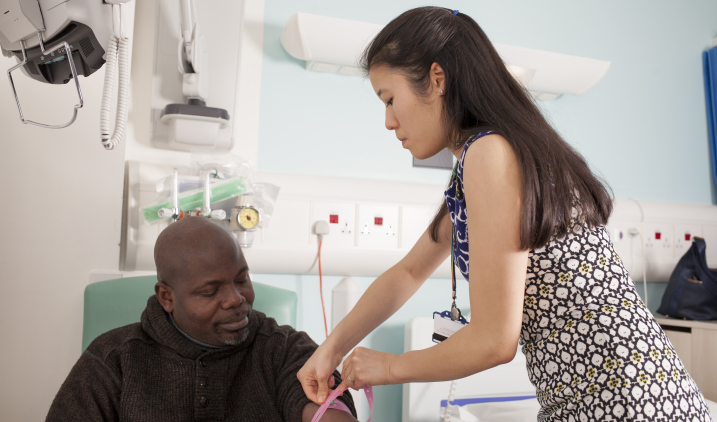
When taking blood, you have to be careful that you
- don’t harm the patient
- don’t disturb any nursing care that the patient is receiving
- take the blood correctly so it can be used for testing
- label the samples carefully
- store the blood correctly
- deliver the samples promptly to the lab
Patients may be nervous about having their blood taken, so you have to reassure them and put them at ease. Phlebotomists may work in hospitals, clinics or health centres. You may visit patients at home or in residential or care homes.
Depending on where you're based, you will work as part of a team with nurses, healthcare science staff working in blood sciences, biomedical scientists, GPs and other healthcare staff. You may work as a healthcare assistant, and then receive training in phlebotomy so that you can take patient's blood.
Entry requirements
There are no set entry requirements to become a trainee phlebotomist. Employers usually ask for at least two GCSEs or equivalent. They may ask for a BTEC or equivalent vocational qualification in health and social care or healthcare.
Employers often ask for relevant work experience. Even where this is not specified, it would be an advantage if you have worked in health or social care, in either paid or voluntary work. There are apprenticeships in healthcare that would give you relevant experience to apply for a trainee phlebotomist position. You could work as a healthcare assistant, and then receive training in phlebotomy so that you can take patient's blood.
Must have skills
As a phlebotomist, you'll need:
- to be caring and kind
- willing to be hands-on with patients
- to be able to put patients at ease - they might feel anxious about giving blood
- able to follow instructions and procedures
- able to work in a team but use your own initiative
- able to explain procedures to patients, careful and methodical
You'll also need:
- good communication skills
- including listening skills
- good organisational and observational skills
Training and development
Phlebotomists are trained on the job and so securing a trainee phlebotomist position is recommended. The training includes theory and practical work including
- how to take blood from different patient groups, including children and the elderly
- different ways to take blood
- health and safety
- anatomy and physiology
- labelling samples
If you take a freestanding course in phlebotomy before applying for a job as a phlebotomist, there is no guarantee of a position within the NHS.
Phlebotomists can become members of the National Association of Phlebotomists (NAP) or associate members of the Institute of Biomedical Science (IBMS) which offer training and conferences for phlebotomists. With experience and further training, you could become a senior phlebotomist taking on more advanced work. You could become a team leader, supervising the work of a team of phlebotomists.
Pay and benefits
Your standard working week will be around 37.5 hours with the need to work flexibly over a seven day period. As phlebotomist, you’ll be paid on the Agenda for Change (AFC) pay system, typically starting on bands 2 or 3. With further training and experience, you could apply for more senior positions at band 4.
You’ll also have access to our generous pension scheme and health service discounts, as well as 27 days of annual leave plus bank holidays.